Life cycle of automotive glass

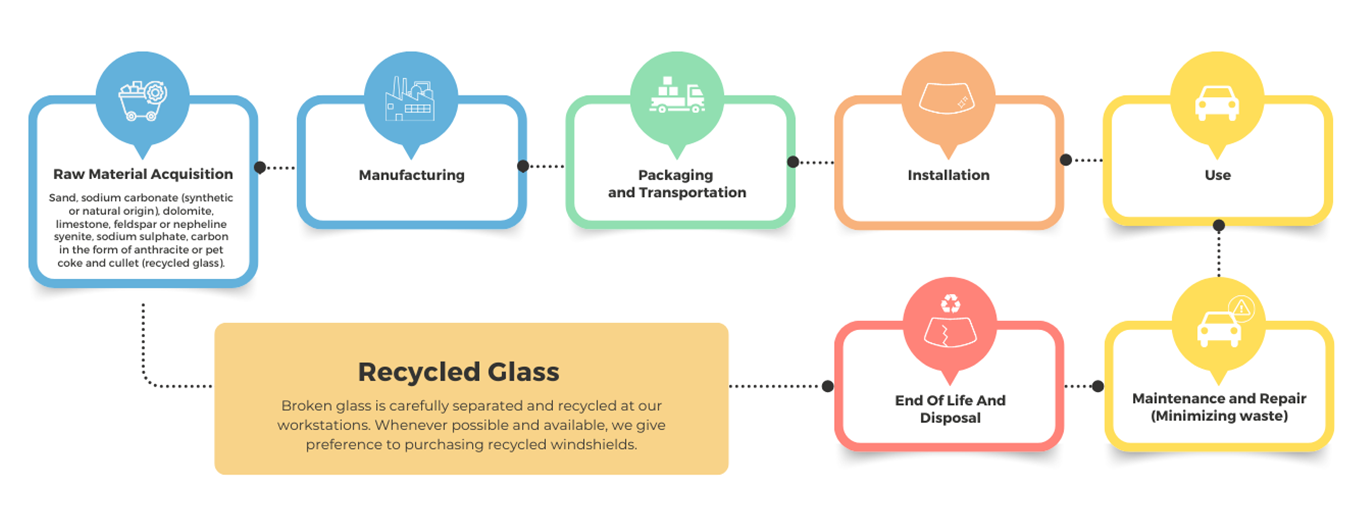
The lifecycle of a windshield entails various stages, spanning from its manufacturing to eventual recycling. In alignment with our commitment to sustainability, AGE actively promotes a circular economy model. By prioritizing the utilization of recyclable materials and advocating for the enhancement of automotive glass durability and lifespan, we endeavor to minimize landfill waste and foster sustainable practices across the industry.

Automotive Glass factory, robot , automotive glass

Here are the general stages in the lifecycle of a windshield:

1. Raw Material Acquisition

The first stage in the lifecycle of a windshield is the acquisition of raw materials:
Sand, sodium carbonate (synthetic or natural origin), dolomite, limestone, feldspar or nepheline syenite, sodium sulphate, carbon in the form of anthracite or pet coke and cullet (recycled glass).

2. Manufacturing

Once the raw materials are acquired, the next stage is the manufacturing of the windshield. The glass sheets are cut to the desired size and shape, and then heated to soften them. A layer of PVB is placed between the two sheets of glass, and the three layers are bonded together under heat and pressure to form the laminated safety glass.

The windshield is then cut to its final size and shape, and any necessary coatings, adhesives, and sealants are applied.

3. Packaging and Transportation

After the glass is successfully manufactured and verified to comply with the highest quality standards, it is meticulously packaged, typically in environmentally friendly materials such as wood or recyclable cardboard boxes. Priority is given to transporting the glass in carbon recyclable boxes, aligning with our commitment to sustainability. These carefully packaged products are then transported to our warehouses, where they await distribution to our workstations worldwide.

4. Installation

The fourth stage in the lifecycle of a windshield is the installation of the windshield in a vehicle by our workstations. The windshield is installed by a professional technician, who will remove the old windshield, clean the area around the windshield, and install the new windshield using premium adhesives and sealants.

5. Use

Once the windshield is installed, it enters the use stage of its lifecycle. During this stage, the windshield is subjected to various environmental factors such as wind, rain, sun, and temperature changes. It may also be subjected to impact from rocks, debris, or other objects.

6. Maintenance and Repair

The windshield may require maintenance and repair to address issues such as cracks or chips. Minor damage may be repaired using resin injection techniques, while more severe damage may require the replacement of the entire windshield.

AGE also has Repair Before Replace policies implemented across its network.

7. End of Life and Disposal

If a repair isn’t possible, we meet the final stage in the lifecycle of a windshield - the end of life and disposal.

When a windshield reaches the end of its useful life, we carefully separate it for recycling and turn it into new products. The glass from the windshield can be recycled and used to make new glass products, while the PVB interlayer can be recycled and used as a raw material for making other products.

We partnership with local recycling/waste management organizations, that can help us improve and collect our waste. To to ensure that recyclable materials are collected, processed, and reintegrated into the manufacturing supply chain whenever feasible.